Showing posts with label Resilience. Show all posts

Sunday, May 24, 2020

Savings Likely to Hit At Least 60-year Low


It was there already in 2018 when it matched the 9% it reached after intense cyclone Danielle inflicted a 17.6% contraction to the Mauritian economy. As the table shows savings increased by a tiny bit last year but not enough to avoid the top three worst spots before COVID-19 arrived on the scene. We must also note that SSR is the only Prime Minister to have his two entries in the table linked to two intense cyclones. The other three PMs appear there because of two things. The first is the Sithanen flat tax which has broken the economy. The other is the removal of the tax exemptions which the people of Mauritius had been using to set up their long-term financial plans. 

The situation for Pravind Jugnauth is pretty worrying as all his three years as PM are very bad years for this fundamental statistic of economic resilience. Given that the figure for this year will likely go at the top of the table he should bring back some basic common sense by restoring a sustainable and progressive tax structure and personal deductions. This should start compensating for his extremely poor economic management of the past five years. 

Saturday, October 5, 2019

Flat Tax Hands 750,000 Mauritians Their Worst Share of National Cake


This is something the Gini coefficient won’t be able tell you but the above chart will. So yes, the bottom 60% of Mauritian households have been made more vulnerable by the Sithanen flat tax in the first decade following its implementation creating record inequality at the same time. They had their best shares of the last twenty-five years a quarter of a century ago. Plus we need to remember that since 2006 we’ve been producing some of our smallest national cakes ever thanks in large part to the damage done by the same unsustainable tax structure. Which means 750,000 of us got our smallest share of the tiniest of cakes. Not exactly what you’d call resilience. More on this later.

Sunday, July 14, 2013

How High Should Top Tax Rates Be?


Probably not lower than 25%. See tax rates were as high as 60% when Uncle Nadess was Minister of Finance because we were just emerging from under colonial rule and the country had to be built. From the ground up. And pressing problems solved while diversifying a basket case economy. Treading intelligently, Vishnu was then able to lower taxes by almost 50% because the Labour Party had made the economy a lot more resilient and international conditions were a lot better. 

Rama then committed political hara-kiri by irresponsibly reducing them by another 50% and making an incredible number of dumb moves. This has created a multi-giga rupee toohrooh and a string of problems that, unsurprisingly, has stalled the economy.

Xavier has little choice but to quickly increase top tax rates back to at least 25% to avert soon having to increase them a lot more. Like what the French did recently. He might not though because flirting with brutal political extinction may be quite addictive.

Thursday, February 14, 2013

Heavy Rain Shuts Down Water-Starved Dodoland

Yesterday. And just like in 2008, people have lost their lives too during the past few days. I guess Mauritians again experienced how resilient we are. Some people think we should rename ourselves as Gopialand.

Long live the bean-counters!!!

Monday, August 15, 2011

Why Our Economy Was Not Resilient in 2008

Or in the recent past contrary to what the Financial Secretary would have us believe. Here are a few pointers:
  1. Growth in USD was about -5% in that year.
  2. The Misery Index was close to a 10-year high -- average inflation was 70% higher than under Federation 2.
  3. We missed the rebound in the World Economy in 2010 -- resilience means rebounding by the way.
If you're still not convinced have a look at our little but growing collection on the topic.

Sunday, August 14, 2011

Understanding Resilience: Part 4

To maintain or improve the lot of as many people as possible you need a progressive taxation system and some growth. If you lower taxes by too much the finances of the government will become overdependent on the realisation of higher growth rates. As we've seen happen with the policies put in place by the toxic bean-counting duet.

This cannot make Mauritius more resilient for sure.

Sunday, July 10, 2011

Understanding Resilience: Part 3


We know that too much foreign debt can make a country bankrupt: ask Thailand. Here too we've been taking up too much of it for the past 5 years. Indeed, the share of foreign debt in the total debt of the central government has literally doubled between 2006 and 2010. That's all the more worrisome given that these monies have not been used to improve our competitiveness or reduce frustration levels of the common citizen. Far from it.

Saturday, July 2, 2011

Understanding Resilience: Part 2

Halving top tax rates and easing the purchase of big cars may have provided Ramgoolam with bragging rights: Ferraris, Lamborghinis and loads of other expensive cars routinely slide on our velvet roads.

But as we don't make these gas-guzzling vehicles we had to import them. And we've paid for these babies essentially by selling our land to rich foreigners probably after telling them that we're building a society for the few not for the many. That's not sustainable. And what's not sustainable cannot make us resilient.

And this folly has come at a heavy cost: a carefully crafted masterpiece, our welfare state, has been upset. So that Mauritius has become a less exciting place and FDI has collapsed in the first quarter of the year.

Looks like the toxic party that was sold to Ramgoolam is pretty much over. He should now revert to basic governance. Right away.

Tuesday, June 28, 2011

Changes in Domestic Debt: The Last Decade


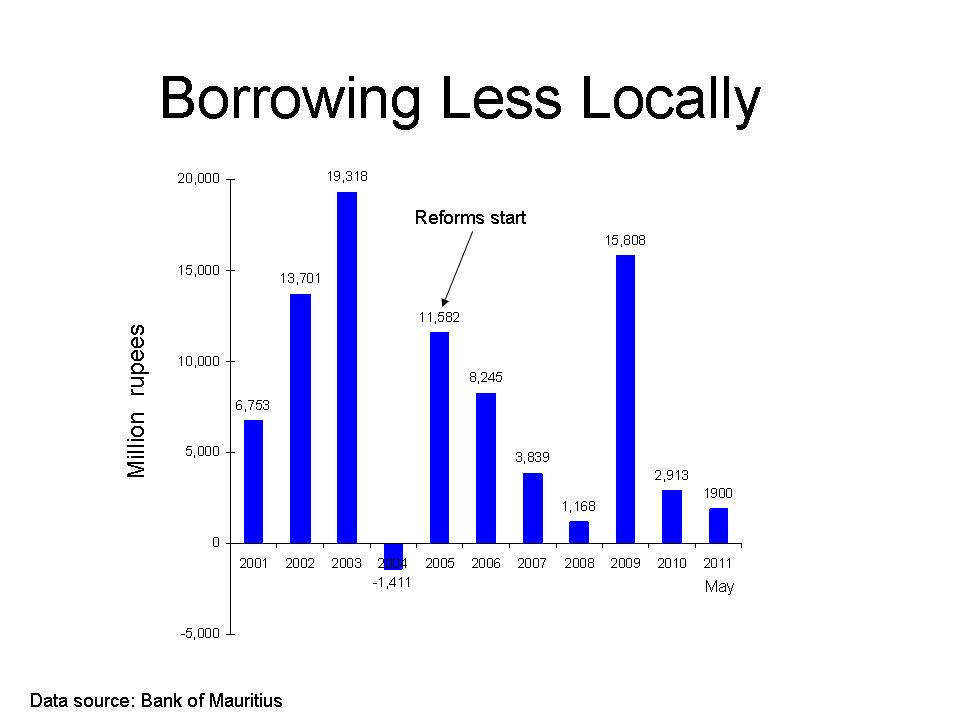
Our domestic debt increased by more than 19 billion rupees in 2003 but government borrowings on the local market has been on a declining since then save 2009. So, have we become more resilient? Not exactly when you take a look at external debt and when you remember that these numbers exclude debt contracted by parastatals and private companies.

Wednesday, January 12, 2011

Economic Resilience: Ramgoolam Style

Rain is late to arrive and that could halve GDP growth. That's an external factor?

Wednesday, July 21, 2010

Mansoor Doubles Foreign Debt in 3 Short Years


By guzzling an extra Rs9 billion. This makes Mauritius more vulnerable and is inconsistent with slogans like 'reforms have saved the economy'. And that's definitely something Africa doesn't want to copy.

Thursday, January 14, 2010

10 Years of Savings Gone in 4 And You're Better Off

That's essentially what Ramgoolam and Dr. Flat Tax want you to believe. Actually it looks like they might even want you to say thank you and probably wouldn't mind if you got on your feet and started clapping.

I always thought you become more vulnerable when your savings decrease because the cushion to absorb any humps in your life becomes smaller. Savings are already at a 30-year low.

Likewise they want us to agree that Mauritius has become more resilient with their reforms. Ahem. How does that happen when you give away Rs5 billion to a sunset industry which accounted at the time for only 4% of our economy. Or by throwing our good money after hubris-infected companies? Or by deciding to borrow in dollars instead of investing in our great people?

Just a little fact for you to see a bit better through Big Brother's propaganda machine: over two financial years (2007 and 2008) our country spent Rs23 billion on debt servicing while we spent only Rs19.6 billion on education. That's close to Rs3.5 billion more.

Where do you think the country is heading?

P.S: You may want to have a look here to find out what was happening in our country in the 1970s just in case you napped through most of it.