Showing posts with label Government. Show all posts

Saturday, June 10, 2017

Heads Roll As May Tries to Form Minority Government

With the help of the DUP. That might not be enough as there have been calls for her resignation within her own party. Jeremy Corbyn is also making plans to form an even smaller minority government. Brits may have to vote again if 2/3 of the MPs so decide or if two different minority governments don't survive a no-confidence motion.

Corbyn ran an effective campaign and promised to "...build a Britain that works for the many, not the few." This included following a worldwide trend of bringing back utilities under public ownership because "...water bills have increased 40 per cent since privatisation, and our private energy providers overcharged customers by £2 billion in 2015."

Saturday, December 24, 2016

SAJ Government May Not Collapse If ML Leaves

Here's a recap of the arithmetic. Lepep wins the General Elections 47-13. They get 4 of the seven additional seats attributed. That brings their total to 51. Add the two MPs of Rodrigues who have traditionally sided with the party who has a majority in Mauritius. Subtract Danielle Selvon who left the Sun Trust about a year ago. And the 11 MPs of the PMSD. New total 41-28. ML has 7 representatives so if they leave the MSM would have 34 MPs while the opposition 35. Except that Marie-Claire Monty looks like she's going to stay in Government and the Mouvement Patriotique have already said they are ready to join Lepep. Which would bring us to 37-32. There may be a few defections at the MSM but there are a few MPs that are floating around in the ML and elsewhere that SAJ could tap into.

It wouldn't be the first time one of our governments managed Mauritius with a paper-thin majority. Trust you're enjoying one of the big advantages of our excellent FPTP system: partners of an alliance may leave but we'd still not have to go to the polls. At least not immediately.

Friday, November 13, 2015

Waiting Better Than Massive Bat Culling

Our flying fox had been red-listed by the International Union for Conservation of Nature (IUCN) because its population was expected to decline by about a third in the next twenty one years. Culling 18,000 bats is equivalent to exterminating 20% of the species -- in a few weeks -- if you think there are 90,000 of them. Additional pressure that the endemic bats might find impossible to bear. But wait. Not everybody agrees there are 90k bats: the IUCN puts the actual figure closer to 50,000. Which would mean that the operation under way will be eliminating a third of Zorro Volador Negro de Mauricio.

Projections of the IUCN may also be too optimistic as meteorological data appears to have become increasingly shaky: cyclones and hurricanes have been showing up in places great-grandmothers never thought possible. Plus we've seen several cyclones lining up in our neck of the ocean in the not-so-distant past.

The upshot of all this uncertainty is that we need to tread super cautiously. For sure there seems to be more bats now -- Mauritius has been spared by strong cyclones for several years -- but more people are netting their trees. Which should give government pause to consider other mitigating measures that have been tried elsewhere. Especially given that bats are not the only fruit predators in town. And in any case many of them will not survive a major cyclone.

Wednesday, September 24, 2014

Why Labour/MMM Alliance is Dangerous

I'll give you three reasons.
  1. It wants to change our excellent system of government – one of our most precious assets – for something inherently unstable to satisfy the fantasies of a couple of politicians. We don't want to do this as it would open a can of constitutional worms. Our Westminsterian system of government has enabled four smooth changes of government since 1968. This has allowed us to forge ahead at a healthy pace until 2005. And established our reputation as a vibrant democracy.
  2. It wants to make all kinds of dangerous changes to our electoral system on the basis of a very weak report which has been demonstrated to be flawed beyond repair. That includes party lists which shift the loyalty of MPs from voters to their leaders. And double candidacies which are a recipe to make arrogant politicians unaccountable.
  3. Sithanen has been chosen as its Minister of Finance. His regressive 'reforms' which began in 2005 have thrown 22,000 Mauritians into poverty – that's 17% of all poor people – and thousands more into a 9-year L-shaped recession. And he has proved to us that he doesn't understand at least two things: how the economy works and percentages. That's a pretty big skills mismatch.
This alliance will never win a 60-0. Far from it. The political exhumation of the toxic bean-counter will not exactly help. But we will have to vote very wisely – for example Lalit is good, Rezistans not really and abstaining bad – and send a very clear and loud message that we don't want any of this nonsense.

Saturday, June 28, 2014

Constitution Temporary Provisions Bill Published

Yep. Government has published the temporary provision bill which will be debated and possibly adopted in our Parliament next Friday. The latter will be exceptionally open for the occasion. And given how tired the few MPs who will speak on that day will be our august Assembly will enter another indefinite period of prorogation. Right after.

As everybody knows no pressing national problem should get in the way of a well-earned rest.

Happy Christmas!!!

Sunday, July 21, 2013

Why Government Securities Are The Safest

Because of two things it can do that private corporations cannot. The first one is to collect taxes and the second one is to print money. So that if a big payment is due the state can always raise income or corporate taxes or have its adviser -- the Bank of Mauritius -- order a container of the good stuff from Thomas de La Rue. But you don't want to play with these levers for day to day matters. Or to compensate for dumb policies. Nope. You want to design policies that are at least sustainable if not thoughtful.

Still these two trump cards puts government in a very strong position to undertake the biggest projects. Which is why, for example, it used to produce all of our electricity through one of its manifestations.

Sunday, June 30, 2013

State Flip Flops On the CNT

First it reallocates routes to private companies because a number of the CNT buses are apparently unfit for our roads. That seemed to have been discovered right after 11 people died recently in a gruesome accident in Soreze. And then workers strike because they feel it's a disguised attempt to privatise their organisation essentially asking why would the most profitable lines be transferred if not to further weaken the company.

Government then u-turns under pressure and hands back the lines. The strike stops but then on Friday Cabinet maintains the reallocation of the routes saying it cannot play with the security of passengers.

Now, isn't that funny? Tolerance for killer buses doesn't seem to be uniform among cabinet members. It would be interesting to find out the safety features of the CNT buses compared to let us say those of the official cars that are provided to Ministers. And about the operational history of each of the buses that the CNT bought over the last 20 years or so. Not bad either if we could be told what exactly was done after the accident in Montebello in 2009 where four people lost their lives.

By the way, how come the state buys sophisticated transport equipment like the Airbus A-340 and then buys crap for the travelling citizens. That too after an early harvest and a bumper crop?

Tuesday, June 28, 2011

Changes in Domestic Debt: The Last Decade


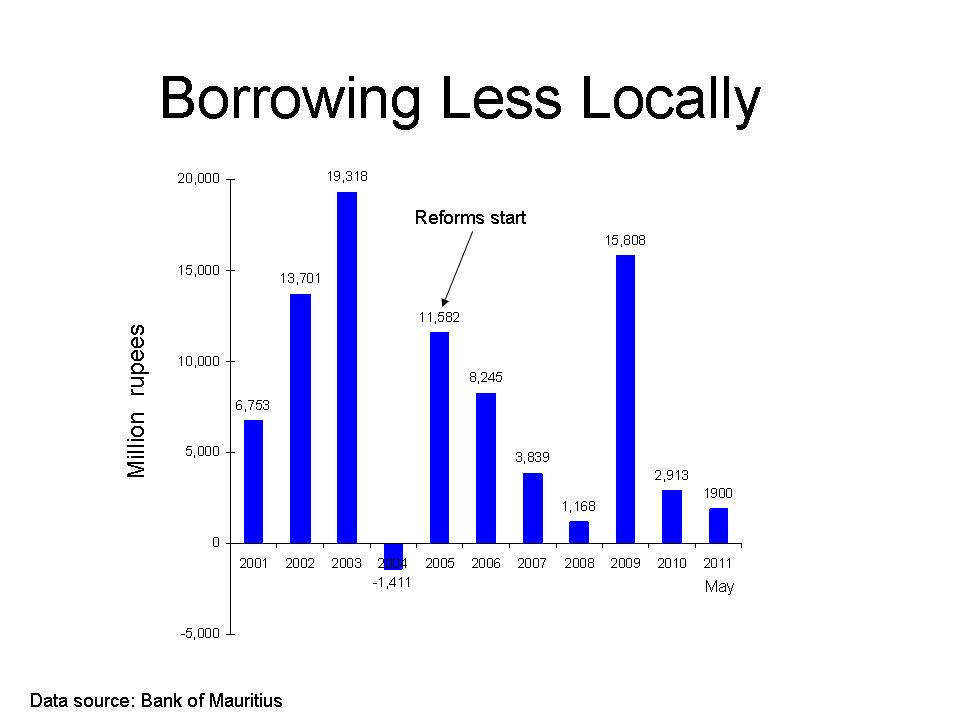
Our domestic debt increased by more than 19 billion rupees in 2003 but government borrowings on the local market has been on a declining since then save 2009. So, have we become more resilient? Not exactly when you take a look at external debt and when you remember that these numbers exclude debt contracted by parastatals and private companies.

Thursday, April 28, 2011

82% of Poll Not Happy With Government


With respect to how it has been managing Mauritius since the last general elections. More than half of these are even extremely unhappy. Granted sample is quite small but it is a fact that people are not very happy in this country these days.

Tuesday, April 20, 2010

Poll Find Berenger Brings More Instability Than Sithanen


58% of the 41 people who voted thought that Berenger brought more instability to a government than Sithanen. It's true that the current leader of the opposition has been sacked by not one but two Prime Ministers in the past. Once in 1983 after 9 months by SAJ and the other by Navin Ramgoolam in 1997.

And if I not mistaken he was also sacked by SAJ between 1991 and 1995.

Sunday, May 10, 2009

How to Make the Stimulus Package Less Opaque

Here are a few basic ideas:

  1. All the names of the beneficiaries should be published as well as a snapshot of their financials (including past profits and gross margin, dividend policy, top management's salaries and other perks over a five year period)
  2. Summary of the reasons why taxpayers' money was dished out to them
  3. The names and resumes of the independent financial analysts involved should be made public
  4. The parameters that are going to be monitored have to be available and the circumstances under which the state will pull out
  5. The government auditor should evaluate the program on a monthly basis and its report should be placed on the net
That's a start of course.

Wednesday, October 15, 2008

Hong Kong Baffles Market Fundamentalists

In a key policy address following the global financial crisis, Hong Kong Chief Executive Donald Tsang states that "the government's role is increasingly important and needs to be redefined ... We should be ready to take decisive action to help stabilize the economy and rebuild people's confidence to ride out the difficulties."

Quite logically, the Hong Kong Monetary Authority (HKMA), the territory's central bank, and the Securities and Futures Commission (SFC) would look for ways to strengthen the city's financial regulatory regime. Among other measures, guess what, Hong kong, one of the champions of global capitalism, is about to establish an advisory Minimum Wage Commission.

Hong Kong has not evolved on the same planned track as Singapore, but they both share the same ideology-free approach to make their vulnerable open economies as lean and nimble as possible.