Showing posts with label First Past The Post. Show all posts
Showing posts with label First Past The Post. Show all posts
Monday, November 11, 2019

Sunday, December 9, 2018
Why Electoral Reform Got Sidetracked For a Couple of Decades
The first reason is that the really smart politicians who understood the dangers of proportional representation (PR) passed away thirty or more years ago and were not replaced by a crop of a similar calibre. SKJ and SSR died in 1985 while Renganaden Seeneevassen who was one of the fiercest critic of PR was gone even earlier – he died in the middle of 1958. The only politician of that generation who is still active is SAJ which would explain why he dubbed PR a komeraz. But then again he doesn't seem to fully understand all the risks of PR. This is reflected in the dangerous bill on electoral reform before parliament. It has failed to address the problems with government formation countries encounter when they add a dose of PR to a first-past-the-post (FPTP) system. And we definitely cannot count on Navin Ramgoolam and today's Labour Party to bring wisdom to the debate. They're deeply mired in trickle-down economics and bean-counting.
The second reason is terms of reference (TOR) that were too narrow. From Sachs to Sithanen only PR solutions were considered although better non-PR solutions exists. There was even a brief attached (see screenshot) by the MMM to the TOR of the Sachs commission. It's fine to raise an eyebrow. The big plus of course is the internet. Ideas can spread a lot faster than before in our hyperconnected world.

The second reason is terms of reference (TOR) that were too narrow. From Sachs to Sithanen only PR solutions were considered although better non-PR solutions exists. There was even a brief attached (see screenshot) by the MMM to the TOR of the Sachs commission. It's fine to raise an eyebrow. The big plus of course is the internet. Ideas can spread a lot faster than before in our hyperconnected world.

The Real Reason Politicians Want Dose of PR

So what's the reason for a dose of PR and increasing the size of a parliament that voters across party lines already find way too big? Easy. To create a class of MPs that's a lot more difficult to remove in a general election as shown in the chart above.
Make sure your MP knows you don't want this.
Saturday, August 11, 2018
Meet One More Gigantic Flaw of the SEG
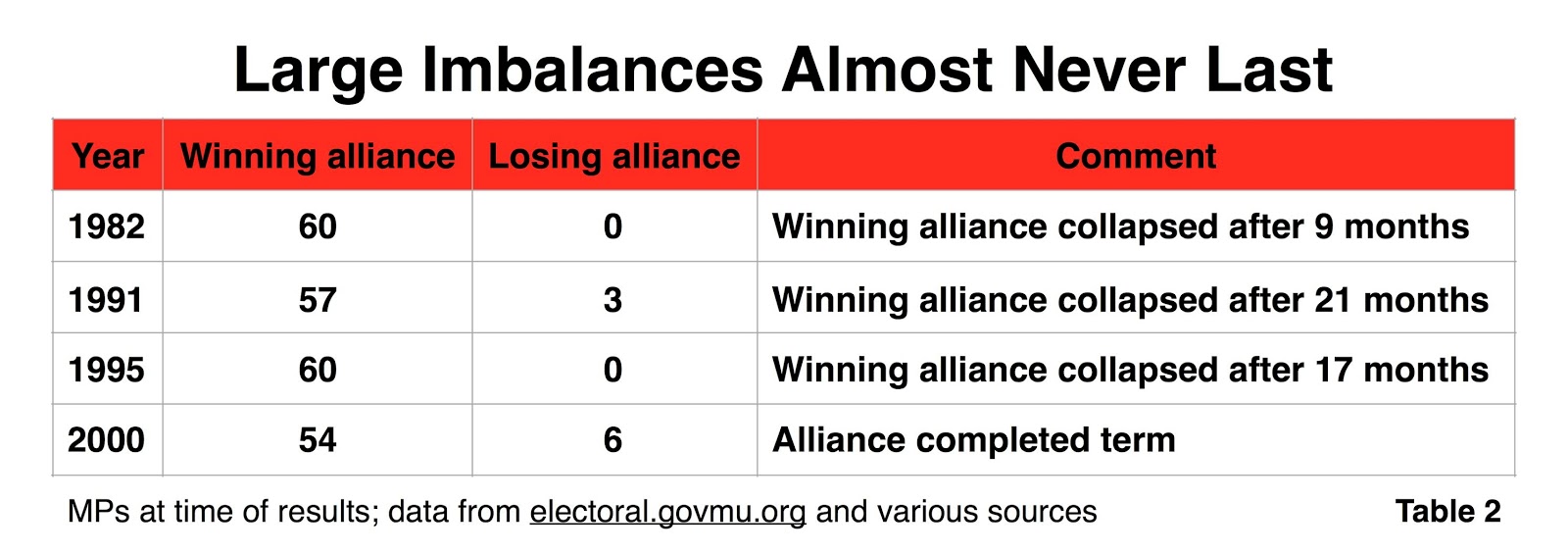
Last June we exposed another huge flaw of the SEG (Sithanen Electoral Galimatia) namely that government formation could take a lot more time to happen – we'd move from a few days to several months and we might even have to go vote again. But that proposal which was dumped by voters in December 2014 also ignores the important fact that the biggest imbalances that our FPTP produced didn't last that long. As Table 2 shows three out of the four broke down by the 21st month and I know that a large number of MPs shifted into the opposition in at least two of them.
Now given that the SEG would have allocated all 20 PR seats to the losing alliance in 1995 and that the winning one had distributed the electoral tickets 35 to 25 Ramgoolam's government would not have survived a motion of no-confidence if at least 22 MPs shifted into the opposition when the alliance collapsed. And this can happen to government after government.
Naturally these flaws and the others we've discussed before are likely to combine to poison the political atmosphere of our country. Essentially doing what the Sithanen flat tax has done to the Mauritian economy.
Sunday, June 17, 2018
SEG Found to Have At Least Two More Giant Flaws
SEG stands for the Sithanen Electoral Galimatia and the first giant flaw is that government formation could take a lot more time after the polls reveal their secrets. How much more time? Well you can look at some of the recent experiences of countries where the electoral setup is either a proportional representation (PR) system or a mixture of PR and First Past The Post (FPTP). This is summarised in the table below. So including a dose of PR might leave us without a new government for as long as six months. This compares pretty unfavourably to the seven days it took us here in 2014.

And there is worse. If no government is able to emerge from a general election for a given period of time we may need to vote again as it's going to happen in Italy soon. Plus I believe the cost of a general election is in the neighbourhood of Rs300m. The cost is even greater for sticking with a caretaker government in the meantime as it would not feel it has popular support to carry out important work. Mauritius cannot afford so much uncertainty. That's for sure. God bless our FPTP system.
What about at least another giant flaw? Stay tuned.

And there is worse. If no government is able to emerge from a general election for a given period of time we may need to vote again as it's going to happen in Italy soon. Plus I believe the cost of a general election is in the neighbourhood of Rs300m. The cost is even greater for sticking with a caretaker government in the meantime as it would not feel it has popular support to carry out important work. Mauritius cannot afford so much uncertainty. That's for sure. God bless our FPTP system.
What about at least another giant flaw? Stay tuned.
Sunday, December 10, 2017
8 Essential Questions Voters in No. 18 Must Ask Themselves
1. Do you like what has happened to your beautiful town or neighbourhood over the past 11-12 years? You know like a proliferation of casinos and all the bad things that come with it.
2. You've invested in the education of your children. Their skills are needed to solve the problems of our country. Are they doing meaningful work and being provided with numerous opportunities to make our country move forward and remain the beautiful garden it has been for so long? Or have they gone elsewhere as too many doors are shut here?
3. Do you remember the wicked plan to turn our country into a banana republic that was hatched by Sithanen, Ramgoolam and Berenger in 2014? Doesn't it look like they will try that again banking on how unhappy Mauritians are with the poor performance of the Lepep government?
4. There's about 1,200 billion rupees of GDP missing from what Sithanen promised for slashing top tax rates starting in 2006. That's more than Rs10 billion of government revenue which could have been spent in every constituency including yours. The Lepep government has also given unreasonable tax breaks. Do you want to have to work harder and for less because of parties like the MMM, Labour Party, MSM and PMSD work for the few and not for the many?
5. Do you remember what happened to the savings plan you built over several years when an incompetent finance minister started taxing your interest income because he had to make the rich pay less taxes?
6. Shouldn't the level of debate in our Parliament be raised so that solid solutions to matters of national interest are found?
7. Our electoral system (FPTP) makes it quite easy for us to keep politicians out of parliament. The MMM, LP and Rezistans ek Alternativ want to remove this right from us with a dangerous modification called double candidacies. Do you want to vote for candidates from such parties?
8. The bottom 70% of households saw their share of the national cake fall to 20-year lows in 2012 while the policies started by Sithanen and maintained by governments with ministers from the LP, PMSD and MSM have thrown a record 22,000 extra people into poverty. Do you want this to go on or do you want to bring sanity back?
2. You've invested in the education of your children. Their skills are needed to solve the problems of our country. Are they doing meaningful work and being provided with numerous opportunities to make our country move forward and remain the beautiful garden it has been for so long? Or have they gone elsewhere as too many doors are shut here?
3. Do you remember the wicked plan to turn our country into a banana republic that was hatched by Sithanen, Ramgoolam and Berenger in 2014? Doesn't it look like they will try that again banking on how unhappy Mauritians are with the poor performance of the Lepep government?
4. There's about 1,200 billion rupees of GDP missing from what Sithanen promised for slashing top tax rates starting in 2006. That's more than Rs10 billion of government revenue which could have been spent in every constituency including yours. The Lepep government has also given unreasonable tax breaks. Do you want to have to work harder and for less because of parties like the MMM, Labour Party, MSM and PMSD work for the few and not for the many?
5. Do you remember what happened to the savings plan you built over several years when an incompetent finance minister started taxing your interest income because he had to make the rich pay less taxes?
6. Shouldn't the level of debate in our Parliament be raised so that solid solutions to matters of national interest are found?
7. Our electoral system (FPTP) makes it quite easy for us to keep politicians out of parliament. The MMM, LP and Rezistans ek Alternativ want to remove this right from us with a dangerous modification called double candidacies. Do you want to vote for candidates from such parties?
8. The bottom 70% of households saw their share of the national cake fall to 20-year lows in 2012 while the policies started by Sithanen and maintained by governments with ministers from the LP, PMSD and MSM have thrown a record 22,000 extra people into poverty. Do you want this to go on or do you want to bring sanity back?
Thursday, August 24, 2017
What Do You Know About the Sachs Commission?
The one about electoral reform. It's mentioned so often by politicians. But as a thinking-person what have you taken away from it? How would you explain it to a friend in a couple of minutes. Incidentally there was also a select committee on electoral reform chaired by Ivan Collendavelloo in the early 2000s. Do you know what were its recommendations and if they make any sense to you?
Monday, April 3, 2017
FPTP is a Special Kind of PR System

One that comes with a majority prize. It's a great system as it generates stable government after stable government. This has enabled Mauritius to achieve what it has. Its disadvantage is that a few times the prize may get too big. As we've seen in 1982, 1991, 1995 and 2000. But on the first three of those occasions the alliances did not last very long: between nine and twenty-one months. Which means that our first-past-the-post (FPTP) system saved us from going to vote a number of times because it's not a system which is vote wise and outcome foolish. Plus there are smart ways of correcting the most extreme of its scenarios without resorting to totally undemocratic devices like party lists that would rob voters of an important weapon: the final word to dump a politician.
Adding PR seats to our FPTP setup is not an option as we've seen what happened in Rodrigues election after election. It will eat away the stability that the majority prize provides and which is necessary for governments to operate properly. Besides our parliament is already too big.
A European joke captures well how lucky we are to have the FPTP system here:
What is European paradise?
British parliamentary system (FPTP)
German engineering
French cuisine
Italian romance
And European hell?
Italian parliamentary system (PR)
French engineering
British cuisine
German romance
Britain has had 20 governments in 100 years. Italy, 20 governments in 5 years.
In fact Italy has had 62 governments between 1946 and 2013. But you get the point.
Tuesday, February 14, 2017
Air Asia Drops a Paradise, Adds Another One
Guess you heard they are pulling out for Mauritius. After only four months. Wonder why and how it is related to other recent airspace decisions. It's a loss for Mauritius as they offered interesting links to Asia at prices that partly made up for the continuous slaughtering of our currency. But they don't look too worried. They've just opened up a route to our sister paradise in the Pacific.
And of course proportional representation (PR) has created another huge mess in Rodrigues. A very comfortable majority of 10-2 for the OPR has melted into a regional government that will be a lot weaker. This of course comes right after the mess of 2012 when the wish of the voters ended up being frustrated with the same PR seats. What we saw on Monday was kind of expected wasn't it? Just like having mutating 'experts' in electoral reform put their hairdryer into high gear to try to confuse us with jargon they don't understand very well. Besides it was kind of obvious that the Duval Committee was on shaky grounds. And we know PR will produce unstable governments. After unstable governments. But did we have to use Rodrigues as a guinea pig? And that too for 5 years running?
And of course proportional representation (PR) has created another huge mess in Rodrigues. A very comfortable majority of 10-2 for the OPR has melted into a regional government that will be a lot weaker. This of course comes right after the mess of 2012 when the wish of the voters ended up being frustrated with the same PR seats. What we saw on Monday was kind of expected wasn't it? Just like having mutating 'experts' in electoral reform put their hairdryer into high gear to try to confuse us with jargon they don't understand very well. Besides it was kind of obvious that the Duval Committee was on shaky grounds. And we know PR will produce unstable governments. After unstable governments. But did we have to use Rodrigues as a guinea pig? And that too for 5 years running?
Thursday, December 22, 2016
Busy Year For The Jag!
Ten posts have been published in 2016 so far. So we returned after about a year (last time we took a pause of five years). Here's the gist of what we said.
Ramgoolam doesn't understand that FPTP, progressive taxation and spotting talent are core elements of the DNA of the Labour Party. Lutchmeenaraidoo shifts to Foreign Affairs but SAJ is in the mood for an economic miracle. Looks like voters are on track to resume one of their favourite habits.
Mauritius has far more important things to worry than Brexit. One such thing is the current Governor at the BOM. What the pound hasn't seen in 31 years we've seen here in the first 69 days of the return of Basant Roi. We showed how the Sithanen flat tax has spun public finances out of control and seriously damaged our economy. That of course provided Pravind Jugnauth with a great opportunity to bring some basic common sense back.
Mauritius is losing the battle against poverty because of the flat tax. Abysmal policy-making has transformed the economy into a machine that throws 1,000 people into poverty every three months. Little will change until policies start making sense again. The Minister of Finance fails to defuse a time bomb that is rapidly reaching a trillion rupees. Instead he presents a bland budget that will not take Mauritius anywhere we want to go. Tic tac. Tic tac.
We debunked a few myths about our excellent FPTP system. And we illustrate how wise voters are in ranking unsuccessful candidates. America can learn from our experience with trickle-down economics. The Duval Committee is like the 2014 Faugoo Committee. We formalise the concept of minimum opposition size which tweaks our excellent FPTP system in a mindful fashion to solve a couple of important problems.
Monday, November 28, 2016
Trump Election Not Like December 2014
Clinton lost partly because she neglected too big a segment of American voters and thought a bit like she did in 2008 that 1600 Pennsylvania Avenue was hers for the taking. That was a big contrast with Trump who was very efficient in appealing to the reptilian brains of enough voters who don't understand for example that his proposed 15% flat tax is going to hurt them the most. These voters seem to be oblivious to how Reaganomics increase US debt from one to four trillion dollars in twelve years back in the 1980s. And what threw America into its worst recession in almost eight decades in 2008.
So that's very different from what happened here in 2014. It looks a lot more like the June 1982 elections when voters were not sophisticated enough to compensate for the lack of relevant information to take the decision that was in their best interests. But we've become increasingly smarter since then as a careful study would show. Intelligent enough to reject the wicked plan of a scheming trio two years ago.
So that's very different from what happened here in 2014. It looks a lot more like the June 1982 elections when voters were not sophisticated enough to compensate for the lack of relevant information to take the decision that was in their best interests. But we've become increasingly smarter since then as a careful study would show. Intelligent enough to reject the wicked plan of a scheming trio two years ago.
Saturday, April 30, 2016
Top Three General Elections
No. 3. July 2005. Labour and allies do something which was thought almost impossible until then: one of the three main parties beating the other two. And that too by a comfortable margin. Ramgoolam is also the first political leader to stage a comeback as PM for 5 years. Without an exit clause. They double up a few months later by winning all five municipalities.
No. 2. December 2014. What a beauty! Against all odds -- and crappy simulations -- Jugnauth rides back to power on strong voter opposition to replacing our iPhone of electoral setup -- God bless our FPTP system -- with the dangerous Sithanen electoral stupidity. Voters collectively stun almost everyone with their intelligence by keeping Ramgoolam, Boolell and many others out of parliament. To also thwart Ramgoolam's silly fantasy of becoming President à la frenchie.
Can't be another one. August 1967. The elections to set Mauritius free. To get our national flag flying high seven months later. And an opportunity for a couple of mavericks to prove Meade wrong. And deliver unprecedented upward social mobility to tens of thousands through the mindful combination of the welfare state, progressive taxation, the FPTP system, the Westminsterian system of government and visionary policy-making.
No. 2. December 2014. What a beauty! Against all odds -- and crappy simulations -- Jugnauth rides back to power on strong voter opposition to replacing our iPhone of electoral setup -- God bless our FPTP system -- with the dangerous Sithanen electoral stupidity. Voters collectively stun almost everyone with their intelligence by keeping Ramgoolam, Boolell and many others out of parliament. To also thwart Ramgoolam's silly fantasy of becoming President à la frenchie.
Can't be another one. August 1967. The elections to set Mauritius free. To get our national flag flying high seven months later. And an opportunity for a couple of mavericks to prove Meade wrong. And deliver unprecedented upward social mobility to tens of thousands through the mindful combination of the welfare state, progressive taxation, the FPTP system, the Westminsterian system of government and visionary policy-making.
Sunday, October 25, 2015
SAJ's Comments on Electoral Reform Refreshing
Rightly calling PR a komeraz. Who wouldn't? After seeing what happened to election results in Rodrigues. It's the same feeling one got when going through the dumb and dangerous Sithanen electoral galimatia: a heap of rubbish that doesn't take more than a couple of minutes to demolish. A bit like his 2005 promise that a flat tax would generate average robust growth rates of 8% forever after: 2015 will be the 5th consecutive year growth rates will be less than half of that.
Besides PR is so unLabour: Phillippe Rozemont was expelled from the Labour Party when he voted in favour of it. And roughly six decades later Navin Ramgoolam lost power and his seat after he flirted with PR. When an overwhelming number of Mauritians -- using an attractive feature of our wonderful FPTP system but one that Sithanen wants to get rid of with party lists -- said no to an electoral proposal that is vote wise and outcome foolish. There is no need to use a bazooka to get rid of a very mild headache.
Refreshing indeed. Reminded me of what another of our PMs said back in May 2010: "Ki zot tile? Pran zot dan godi dir ayo papa Euro! Euro! donn zot bibron? Pa Pwena! Devaliasyon zame tienn solisyon. Nu bizin vinn pli konpetitif".
Besides PR is so unLabour: Phillippe Rozemont was expelled from the Labour Party when he voted in favour of it. And roughly six decades later Navin Ramgoolam lost power and his seat after he flirted with PR. When an overwhelming number of Mauritians -- using an attractive feature of our wonderful FPTP system but one that Sithanen wants to get rid of with party lists -- said no to an electoral proposal that is vote wise and outcome foolish. There is no need to use a bazooka to get rid of a very mild headache.

Refreshing indeed. Reminded me of what another of our PMs said back in May 2010: "Ki zot tile? Pran zot dan godi dir ayo papa Euro! Euro! donn zot bibron? Pa Pwena! Devaliasyon zame tienn solisyon. Nu bizin vinn pli konpetitif".
Friday, October 3, 2014
Your Free Guide To Recent Additions on The Jag!
Sithanen trying to be funny: he's worried that the savings rate is too low. It's like the dog which is scandalised that the sausages that were left under its supervision are gone. We show the extent of the unmitigated mess created by his severe skills mismatch as Finance Minister and why his story doesn't add up.
Our first piece on electoral reform appeared in April. We show how government has been wasting precious time on this issue and how by adopting the dumb and dangerous Sithanen report we're not going anywhere good. We have a critical look at the criteria the state wants to use and propose a couple. We also list some of the interesting ideas that surfaced.
We connect two dots that have the potential to dramatically shrink our democratic space: the 15% flat tax and the perverse Sithanen Electoral Galimatia (SEG).
In our second piece on electoral reform we show that we don't have to seriously reduce the democratic space to meet the UNHRC ruling and make our excellent FPTP system a little less unfair. We also illustrate how quotas for women translate into a glass ceiling. And that our parliament is already too big. Finally we show how the concept of opposition MPs offers a simple -- not simplistic -- solution.
The third instalment on electoral reform makes the point that the constitutional amendment is flawed. And comes forward with a governance-based alternative. While highlighting the urgency of referendum legislation.
A piece on Gandhi's transformation: from shy person to anything but. With a nice personal story about Filip Fanchette.
Our first piece on electoral reform appeared in April. We show how government has been wasting precious time on this issue and how by adopting the dumb and dangerous Sithanen report we're not going anywhere good. We have a critical look at the criteria the state wants to use and propose a couple. We also list some of the interesting ideas that surfaced.
We connect two dots that have the potential to dramatically shrink our democratic space: the 15% flat tax and the perverse Sithanen Electoral Galimatia (SEG).
In our second piece on electoral reform we show that we don't have to seriously reduce the democratic space to meet the UNHRC ruling and make our excellent FPTP system a little less unfair. We also illustrate how quotas for women translate into a glass ceiling. And that our parliament is already too big. Finally we show how the concept of opposition MPs offers a simple -- not simplistic -- solution.
The third instalment on electoral reform makes the point that the constitutional amendment is flawed. And comes forward with a governance-based alternative. While highlighting the urgency of referendum legislation.
A piece on Gandhi's transformation: from shy person to anything but. With a nice personal story about Filip Fanchette.
Tuesday, March 25, 2014
Ramgoolam Publishes His White Paper, Finally
And he is giving you 42 days to read it and to send your submissions compared to the 389 days it took him to get it out. This kind of defeats the purpose of having a white paper. The deadline will definitely have to be extended to September.
Saw that the proposal of the government contained in the report is based on the perverse and dangerous Sithanen electoral galimatia. Oh boy! Labour is braindead!
Monday, January 7, 2013
Party Lists Have Undermined Accountability in SA
According to The Economist which ran an interesting article on South Africa last October. The famous magazine rightly concludes that individual MPs don't worry about voters anymore: they instead bend over backwards to please party leaders who determine how far they end up from the top of the list.
Guess it too is saying that party lists are evil.
Guess it too is saying that party lists are evil.
Sunday, April 8, 2012
Cuttaree Could Be Getting Ready
To spend five years at Le Réduit as part of an LP/MMM alliance. The other ingredient of this partnership would be a change in our constitutional regime -- a move to a Presidential system -- along with an electoral reform that would include a dose of PR. As wished by both Berenger and Ramgoolam. This scenario is not as unlikely as you may think because remember that a quarter of MMM's central committee voted against the principle of the 2000 Remake.
The other reason is that the chemistry between Paul and Navin is better than between the other protagonists. Of course changing the constitutional setup will not make our current slate of politicians any wiser. So your lot will not improve. Only theirs.
The other reason is that the chemistry between Paul and Navin is better than between the other protagonists. Of course changing the constitutional setup will not make our current slate of politicians any wiser. So your lot will not improve. Only theirs.
Tuesday, January 31, 2012
How To Deepen Our Democracy
First we need to empower our MPs to raise the level of debate so that our representatives deliver better outcomes. We can do this by attaching a vigorously independent Parliamentary Policy Office (PPO) to our National Assembly modeled after the Congressional Budget Office in America. The PPO would analyse policies and issue informed and increasingly respected opinions. Check this sample report to get an idea.
Second we should make sure we always have a functional opposition. Given that our parliament is already too big we can do this by splitting back our 20 three-member constituencies to 40 one-member ones just like they were in 1959 and 1963. And then allocating a maximum of 8 additional seats -- on a non-ethnic basis -- to make sure our opposition has always a minimum of 8 MPs to keep our government on its toes. This would at the same time drastically reduce the unfairness of our FPTP system without compromising its stability.
Reverting to the 1959 set-up will also yield extra advantages including greater proximity between candidate and voters and getting election results a few hours after polling stations close as there would be two-thirds less votes to count.
We don't need to pass new laws to increase the number of women in parliament. There are already three times more women there than in 2000 and this should keep on rising. We certainly do not need any perverse recommendations like double candidacy because this denies citizens the basic privilege of vot ar lipie.
And finally our main parties should have their electoral manifestos released at least 3 weeks before election day. So that voters get an opportunity to sniff them out.
Monday, January 30, 2012
Subscribe to:
Posts (Atom)