Showing posts with label Competitiveness. Show all posts

Tuesday, September 19, 2017

RIP Sugar


It's heading there. Less than 1% of GDP now and declining further. It would already have been dead if so much good money had not been thrown after its bad situation. And if it was not for the completely silly policy of competitive depreciation. I heard Krepalloo Sunghoon mention that it costs Rs17,000 to produce one ton of sugar that now sell for less than Rs15,000. How much bigger would the loss be at the very reasonable rate of 25 rupees to a dollar? No wonder then that thousands of acres of sugar cane have been abandoned. But that's kind of natural. We can't pursue activities that are incompatible with the kind of money that is needed to live properly here. Unless if we want to allow modern forms of slavery like too many seasonal workers and God knows what else. Just like we use cars and buses to go to work. And not horses.

We should use the land under sugar cane to grow food and to create more productive opportunities for our unemployed youth. So that we move Mauritius forward.

Saturday, April 18, 2015

IMF Doesn't Trust Own Currency Valuations

As has been reported by the institution's Independent Evaluation Group (IEG) before. So if the currency models of the IMF have been found wanting I don't see how the Minister of Finance can use them to justify the sneaky double-digit depreciation orchestrated by the BoM. Here's a backgrounder to see clearer.

Wednesday, August 22, 2012

Mauritius At 56th Place in PISA Math Ranking


I believe it's the first time we are participating in this serious survey. And the government is to be praised to finally giving Mauritius an opportunity to see how well our education system stacks up against those of other countries around the world. We're at number 56 in Math. Right up there with Thailand and a lot better than Qatar and Ghana. But not even in the top half of the table. 56 is also quite close to the 54th place we got in the last Global Competitiveness Report.

And here's a clip to understand why we should be talking more often about PISA.

Thursday, July 26, 2012

It's Not The Geography, Stupid

A lot of energy is being wasted on one of our latest fantasies. That we are going to be the bridge between Asia and Africa. That we will be intercepting a lot of the flows and the business between the two continents. Between African Lions and Asian Tigers. That our geographic location gives us a competitive advantage just like Singapore.

It's an awesome strategy if you haven't looked at a map in a long time or don't have an internet connection. Because otherwise you would have known that there is a huge difference between being lost in the open seas and sitting pretty near the narrowest part of the Strait of Malacca. Maybe you are not to be blamed. As you still can't tell the difference between a weak Euro and a strong rupee. Or between rent-seeking and competitiveness.

Asia doesn't need our permission to go into Africa. Because it's already there. 

Thursday, May 24, 2012

Bundesbank To Accept Tiny Bit More Inflation

From its current level of 2.1%. Which means that the Buba could exceptionally allow price levels to increase to a max of 3%. This should help its European trading partners improve their trade relationships with the continent's growth engine. Think of it as Germany accepting to be a tiny bit less competitive -- by willing to take up a little more inflation than usual and that for a short period too -- to help pull its neighbours out of the current crisis. That will not make the German economy grow faster. Nope. It will more likely, albeit barely, reduce the strong clip at which it has been growing as of late.

Bean-counters, rent-seekers and other clowns who advocate a persistent rupee depreciation should not construe this as a justification for Mauritius to take up more inflation. Our inflation rate is already on the high side. Besides monetary policy has never been a substitute for a blatantly ridiculous land use.

Monday, January 23, 2012

Why American Manufacturing Has Been Relocating Abroad

It's not because of lower wages. But because of the overall costs of doing business. So says an interesting 3-part article by Carl Pope. And Barack Obama who will announce what he essentially intends of doing if he gets a second mandate in November when he delivers his annual report card to Congress tomorrow is expected to address these issues.

Indeed, the media has reported that the thrust of a second Obama term will revolve around education, manufacturing and innovation. Which is essentially what Steve Jobs told him he should work on back in October 2010 in order to avoid ending up as a one-mandate President.

Friday, October 21, 2011

How Much Sleep Should You Lose Over The Doing Business Rankings?

None. See, it's not correlated with any of our national priorities. But we just lost 3 spots I hear a few of you say. Indeed, but that's 3 times less than the 9 spots we lost back in 2007, the year of the... ahem... early harvest. Still, given that we don't want our friends at the Joint Economic Council to do anything foolish during the week-end here's something to cheer them up: Mauritius has moved up 50 places in the Logistics Performance Index in the last few years from a miserable 132nd spot. By the way, if you average out our rank in these two indices you end up with 52.5 which is very close to our 54th place in the recently published 2011-2012 Global Competitiveness Report. Which is a more comprehensive yardstick.

Sleep tight.

Saturday, September 17, 2011

Mauritian Interest Rate Spreads Hurting Our Competitiveness

According to the recently published World Competitiveness Index 117 out of 142 countries have better interest rate spreads than Mauritius. Mugabe's are 19 spots lower while Canada's are 101 spots higher. Mauritius was ranked 113/134 in 2007.

We are not world-beaters either when it comes to the savings rate. 97 countries had better savings rates than us last year. Compare that with a couple of years ago when only 24 countries had higher savings rates. 

On dit merci qui?

Tuesday, June 21, 2011

Governor Finds Many Tools But No Magic Wand

That's what he said in a speech a few weeks ago with respect to the typical crazy requests he gets from our beloved GLDs. But he concedes that there has been some progress in this debate. I agree.

What do you think?

Wednesday, November 24, 2010

STC Hedging Mess is Rs1.7 Billion Bigger

So we were told a few weeks ago. That's 57% more than the huge Rs3 billion figure supplied in Parliament two years ago. And quite fishy too because the STC doesn't have any price risk to manage: it just passes it on to us through the APM. Besides, two years that's an awful long time for so many eyes to be fooled.

My hunch is that the STC never had any billion-rupee hedging losses but that we were forced to pay abusive gas prices to make up for the fiscal shortfall created by the Sithanen-Mansoor's flat tax experiment given that the proverbial robust growth rates never arrived. 

This aspect of Shaitanomics has already played a part in preventing us and our economy from participating in the global rebound underway by making a dent in our overall competitiveness. And Pravind Jugnauth's intention of increasing excise duties on petroleum by 10% will make sure it will have another one to play in keeping us in our economic slumber. He should instead increase the special levy on banks or nudge corporate taxes upwards.

All of this doesn't look good for Mo Ibrahim's poster child for governance, does it?

Friday, July 16, 2010

Flat Tax Spins Public Finances Out of Control

That's because the robust growth rates that were needed to sustain the 15% flat tax of Dr. KonnTu and his Bretton-Woods-minted charge nurse never arrived. See, as fiscal receipts depend on growth rates and effective tax rates you can only slash the latter if the former are much higher. Otherwise there won't be any money to solve important national problems or debt levels will spin out of control. A flat-tax also brutally increases the divide between the haves and have-nots.

Unsurprisingly Ministers of the last government have said in private that they were consistently told that there was no money to do anything right from the beginning. So nothing much was done and Mauritius in 2010 is a less competitive place than it was back in July 2005. People have also become poorer and many have lost faith in the future of their country and in their own.

Given that Mauritius will not see any robust growth rates anytime soon matters will get worse and beyond any political repair. Which is why Pravind Jugnauth has to present a new budget. Right away.

Thursday, June 17, 2010

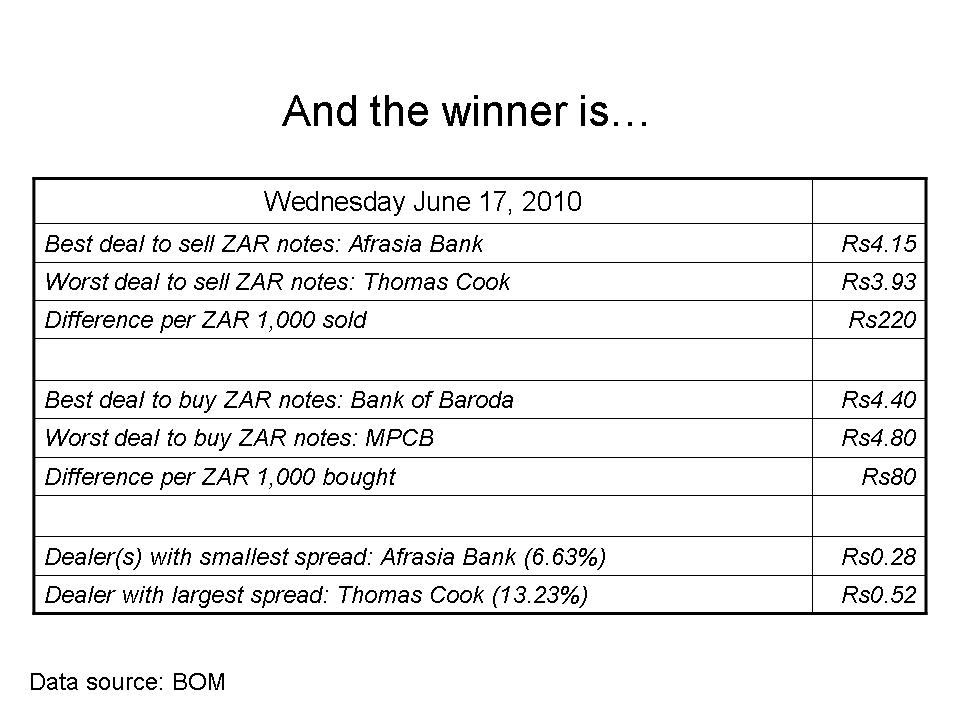
Head To Bank of Baroda if You Need To Buy ZAR


They were selling South African notes at Rs4.40 each according to data from the BOM's page. That would be 8 cents less than MPCB. If you wanted to convert ZAR into rupees then you should have gone to Afrasia Bank which was offering Rs220 more for every 1,000 Rands than Thomas Cook.

The latter had the worst spread on the market at 13.23%: that's twice more than Afrasia's.

Save some bucks: shop around. And tell you friends about it on Facebook.

Monday, June 7, 2010

Dealing in USD Notes Improves Marginally


4 short days after, the difference between the best and worst deal to sell USD has collapsed by 21% (Rs250) to Rs928. That's because Shibani is giving 25 cents more for each of your dollars. And that has reduced its spread, still the largest on that BOM's page though, by 150bps to 7.87%.

Standard Bank still has the best deal for your dollars while Forex Direct will get more dollars for your rupees. The latter has also joined Africa's biggest bank as the place with the smallest spreads.

Thursday, June 3, 2010

Best Places To Deal in USD Notes


If you wanted to sell USD1,000 yesterday then you should have headed to Standard Bank which was offering Rs32.68 for each dollar. That would have put Rs1,178 more in your pocket than if you had visited a Shibani Finance Foreign Exchange counter (we are assuming there are no service charges or that they are the same across dealers).

If you were into buying a thousand bucks instead then it would have been wiser to bring Rs34,080 to Forex Direct. If you wanted to buy them at the MPCB they would have cost you Rs870 more.

Standard Bank had also the smallest spread on USD notes: Rs1.63. Shibani had the largest at almost Rs3.

You can access all the rates in one page from the BOM's website.

Isn't this something l'ACIM or the ICP should have on a blog everyday to help citizens? The Competition Commission should also track the spreads to bring them within international levels.

Monday, May 31, 2010

Pump Prices Remain At Unreal Levels


Almost two years after they collapsed on world markets. The green line represents the evolution of IPE Brent oil after adjusting for the MUR/USD exchange rate while the red one charts local pump prices complimentary of early harvest and bumper crop.

And that's supposed to:

1. have made us more resilient during the financial crisis? 
2. be an external shock?

Beats me!

Saturday, May 22, 2010

The $/€ Rate Since The Launch of the €


Funnily enough you will have trouble forgetting the rate the day the € was launched unless you never heard about la prise de la Bastille: 1.1789). 

For the first three years the new currency lost ground reaching a minimum of 0.8252 on 26 October 2000. But since 6 July 2001 till 15 July 2008 the trend has been resolutely positive moving from 0.8384 USD to 1.5990 USD. That's a 7-year streak if you're paying attention and must have helped build robust reserves for exporters with inputs in USD and sales in EUR.

It then fell quite a bit with the collapse of the oil prices especially in October 2008 but recouped more than half of the decline in the following couple of months.

The USD/EUR rate then trended positively for two quarters beginning March 2009 before starting a negative trend from its local peak of 1.5120 on December 3, 2009. 

It closed at 1.2497 yesterday which is more than 50% its all-time low.

The graph is from the ECB's website. Check out the adjustable data windows.

Thursday, April 29, 2010

Ordinary Citizens Shouldn't Pay For Bad Business Decisions

Sugar is a tiny industry where we're not competitive anymore. Now, if sugar barons want to invest their money in it they're free to do it but Government shouldn't bail them out with our money or depreciate our rupee to help them.

The fact that they may have invested a lot of money in it doesn't matter at all. That only tells us the size of their stupid bet.